2026-07-21
Get It. Fund It. Build It. Run It.
A practical architecture for decisions, handoffs, and accountability across a solar project's life. Four stages. Six decision gates.
Human Pace · The Audio Edition · 7 min
Read the transcript
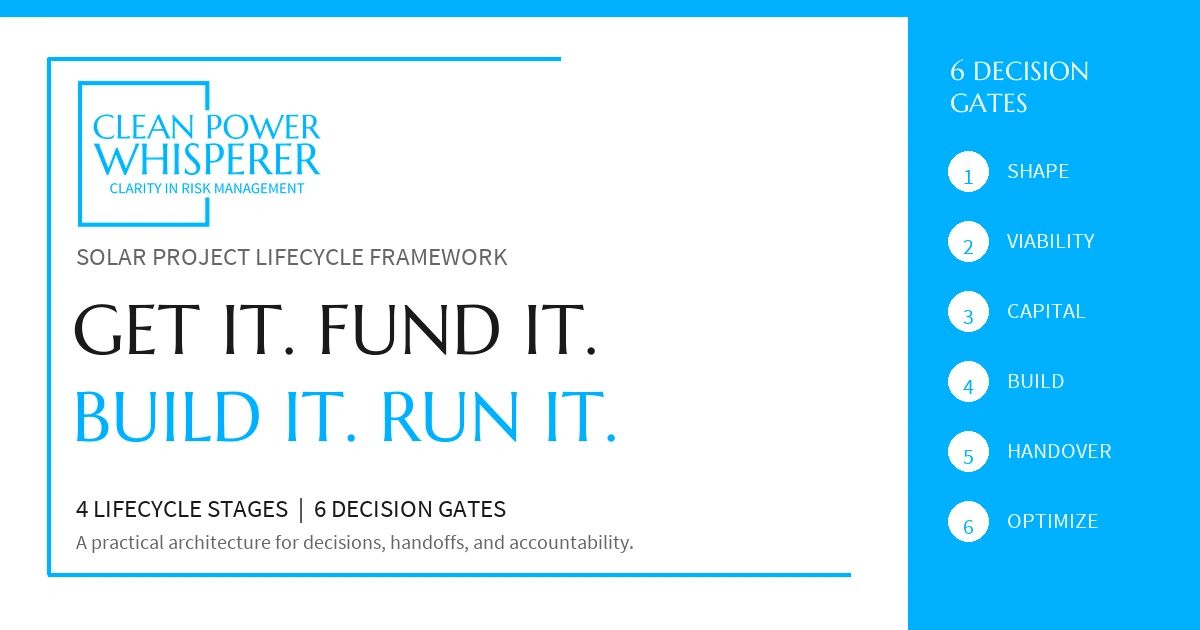
A practical architecture for decisions, handoffs, and accountability across a solar project's life.
Four stages. Six decision gates. Clear owners at every step. Use it to shape a portfolio, prepare an investment committee, or run a project review that actually decides something.
01. Framework Origin
To increase comprehension, I like to simplify:
- Four stages: Get It. Fund It. Build It. Run It. represent the main stages of a project lifecycle.
- Six decision gates: Shape the Opportunity. Secure Project Viability. Commit Capital. Contract and Build. Energize and Hand Over. Operate and Optimize. These gates provide the governance and decision-level definition inside those stages.
02. How to Use the Framework
Step 1: Locate the project: Use Get It, Fund It, Build It, or Run It to identify the lifecycle stage.
Step 2: Identify the gate: Select the decision gate that best describes what must move forward.
Step 3: Frame the decision. Use the decision-gate grid to identify the supporting actions, critical decision, components, desired outcome, and reality check.
Step 4: Assemble the team. Use the function matrix to see who decides, who feeds the decision, and who challenges it.
Step 5: Prepare the decision. Use the Decision-Pack Prompt Toolkit to build the decision pack, test the evidence, and record the outcome.
03. The Four Lifecycle Stages
Where are we in the lifecycle? Every project sits in one of four stages. Get It → Fund It → Build It → Run It

04. The Six Decision Gates
What decision allows us to move forward? Six decision gates provide the governance and decision-level definition inside the four stages.

05. Decision Gate Details
For each gate: the supporting actions, the critical decision, what must be true, what good looks like, and what could make it fail.
Gate 1: Shape the Opportunity
- Supporting Action(s): Find It
- Critical Decision: Where should we play, and which opportunities deserve development resources?
- Critical Components: Market attractiveness, customer need, solar resource, policy support, competitive position, initial site thesis, and commercial potential
- Desired Outcome: A prioritized opportunity thesis with explicit reasons to pursue, test, or reject it
- Reality Check: False demand signals, weak market comparisons, outdated policy assumptions, or unsupported customer conclusions could create an attractive story without a viable opportunity
Gate 2: Secure Project Viability
- Supporting Action(s): Secure It; Prove It
- Critical Decision: Do we control a project that can realistically be permitted, interconnected, contracted, and financed?
- Critical Components: Site control, title and access, interconnection, permitting, environmental constraints, community acceptance, preliminary design, schedule, offtake path, and development economics
- Desired Outcome: A bankable development path with no unresolved fatal flaw and accountable plans for every material dependency
- Reality Check: Missed parcel constraints, superseded grid studies, incomplete agency requirements, or understated stakeholder opposition could make a promising opportunity appear investable
Gate 3: Commit Capital
- Supporting Action(s): Underwrite It; Structure It; Close It
- Critical Decision: Is the risk-adjusted investment financeable on acceptable terms, and should capital be committed?
- Critical Components: Financial model, downside cases, offtake and material contracts, tax and incentives, insurance, technical and legal diligence, debt and equity structure, risk tolerance, and closing conditions
- Desired Outcome: Investment approval, committed capital, defined conditions, executed financing documents, and authority to proceed
- Reality Check: Inconsistent model versions, false precision, omitted obligations, double-counted incentives, or weak downside scenarios could turn a financial model into unsupported confidence
Gate 4: Contract and Build
- Supporting Action(s): Buy It; Construct It
- Critical Decision: Can we execute the contracted project safely, on time, on budget, and to specification?
- Critical Components: EPC strategy, equipment and supply chain, design control, construction plan, health/safety/environmental/quality (HSEQ), critical path, contractor performance, interfaces, cost control, change governance, and builder's-risk protection
- Desired Outcome: An executable delivery plan, controlled baselines, approved changes, recovery actions, and an evidence-based forecast to completion
- Reality Check: Inflated progress, outdated drawings, incomparable bids, hidden dependencies, or schedule pressure overriding controls could produce apparent progress without reliable delivery
Gate 5: Energize and Hand Over
- Supporting Action(s): Commission It
- Critical Decision: Is the plant ready to energize, accept, and transfer to operations?
- Critical Components: Commissioning results, utility approval, performance testing, SCADA and controls, cybersecurity, defects, training, warranties, spares, turnover records, commercial acceptance, and residual risk
- Desired Outcome: A go/no-go decision, commercial operation approval, accepted handover, owned exceptions, and an operating-readiness record
- Reality Check: Premature acceptance, incomplete testing, missing turnover records, unresolved cyber defects, or waived contractual leverage could transfer a physical plant that is not yet an operable business asset
Gate 6: Operate and Optimize
- Supporting Action(s): Operate It; Optimize It; Renew It
- Critical Decision: Are we converting the operating asset into durable cash flow and portfolio value, and what should happen next?
- Critical Components: Production, availability, maintenance, HSEQ, PPA compliance, market exposure, warranties and claims, operating costs, lifecycle capital, refinancing, recontracting, repowering, sale, and retirement options
- Desired Outcome: An operating action plan, value forecast, risk response, lifecycle investment decision, and next-value-cycle recommendation
- Reality Check: Bad telemetry, incorrect baselines, missed contract rights, confused causality, or short-term optimization could damage lifecycle performance and portfolio value
06. Critical Handoffs
Each handoff names the transfer and the minimum evidence that must move with it.
Get It → Fund It
The development team transfers from a promising opportunity to an investable project.
Minimum evidence includes site control, permitting path, interconnection position, preliminary design, offtake strategy, financial model, risk register, and accountable milestone plan.
Fund It → Build It
The financing and investment teams transfer from a financial model to executable authority.
Minimum evidence includes approved capital, executed material contracts, financing conditions, insurance placement, tax and incentive position, notice-to-proceed authority, and controlled baselines.
Build It → Run It
The construction team transfers an operable business asset, not merely a completed physical plant.
Minimum evidence includes commissioning results, utility approval, performance tests, SCADA and cybersecurity readiness, training, warranties, spares, turnover documents, punch-list ownership, and accepted commercial conditions.
07. Function-to-Lifecycle Relationship Matrix
- O = Owner: decision owner or principal accountable function.
- C = Contributor: core contributor to the decision.
- A = Assurance: assurance, advisory, or challenge function.
- — = Limited: episodic or limited involvement.
Functions follow a primary operating-role sequence: Market and Growth; Develop and Deliver; Capital, Governance, and Protection; and Enterprise Enablement. The matrix shows concentration of responsibility, not organizational reporting lines or exclusivity: functions may span multiple lifecycle stages, and multiple owners may appear where gates contain different accountable decisions.

08. Lifecycle-Wide Capabilities
Main capabilities operate across all stages and decision gates:
- Govern the decision — Program Management Office, Legal, Finance, delegated authority, stage-gate governance, and decision records.
- Protect the value — Risk Management, Insurance, HSEQ, compliance, resilience, and cybersecurity.
- Prove the evidence — Data Science, Technical Engineering, source lineage, version control, assumption management, and uncertainty.
- Mobilize the organization — Business Operations, People and Human Resources, Communications, stakeholder management, and executive sponsorship.
09. Decision-Pack Prompt Toolkit
Copy either block into your working tool. Fill in project details before you run it.

Reusable Prompt Builder
Copy the prompt below and replace the bracketed fields.
`You are preparing a decision pack for a solar developer.Decision context
- Lifecycle stage: [Get It / Fund It / Build It / Run It]
- Decision gate: [Gate 1 through Gate 6 and gate name]
- Meeting: [meeting name and cadence]
- Audience: [people in the room or readers of the pack]
- Decision authority: [person or committee authorized to decide]
Critical evidence
- Input 1: [source, document, or system]
- Input 2: [source, document, or system]
- Input 3: [source, document, or system]
Decisions required
- [decision the meeting must make]
Desired output
- [executive summary, decision memorandum, risk report, slides, talking points, or action plan]
Decision integrity requirements
- Cite the source, owner, version, and as-of date for every material fact.
- Separate verified facts from assumptions, estimates, and judgment.
- Identify conflicting evidence, missing information, uncertainty, and unresolved dependencies.
- Do not fabricate project facts, stakeholder positions, approvals, or financial conclusions.
- Assign every action and condition to a named owner with a due date and escalation path.
- Record the decision, approver, date, rationale, conditions, and next gate.
Required response
- Executive summary
- Critical evidence table
- Decision table with recommendation and rationale
- Assumptions, uncertainty, and missing-information register
- Reality check and downside implications
- Actions, owners, due dates, and escalations
- Decision record and next lifecycle gate`
Completed Example — Decision Gate: Commit Capital
`You are preparing the Thursday Project Investment Committee decision pack for a solar developer.Decision context
- Lifecycle stage: Fund It
- Decision gate: Gate 3 — Commit Capital
- Meeting: Project Investment Committee — Thursday
- Audience: Executive leadership, development, finance, legal, engineering, tax, insurance, and risk management
- Decision authority: Project Investment Committee
Critical evidence
- Latest approved project financial model, including version, owner, and as-of date
- Material contract and financing-term summary, including unresolved deviations
- Integrated technical, legal, insurance, tax, permitting, and project-risk register
Decisions required
- Whether to commit the next stage of project capital
- Which conditions must be satisfied before funding or notice to proceed
- Which downside risks require mitigation, contractual protection, contingency, or explicit acceptance
Desired output
- Investment memorandum, sensitivity summary, decision table, approval conditions, action register, and decision record
Apply every Decision Integrity Checklist requirement. Flag missing or conflicting evidence. Do not infer approval, stakeholder intent, or financial certainty that the sources do not support.`
10. Department Scenario Libraries
For more reusable prompt, check out https://solar-project-lifecycle.lovable.app

Sources & Attribution
Clean Power Whisperer Blog is built by T Ngo.
Thought partner with Codex 5.6 Sol.
Audit by Claude Code Fable.
Shipped with Lovable.
← All Perspectives · Next: AI & Climate: The Connection Brief →